
When all she could do was stay.
Ellen had stayed sober through her mother's funeral. Now people kept asking how she was doing, and she was running out of acceptable answers.
An original, AI-assisted fictional story—not a real person’s testimony. Inspired by the episode below.
Published by Deepen Your Sobriety · A project by Chris
How our stories are made
Saturated x Deepen with Pastor Jason Shepperd
Deepen with Pastor Joby Martin · Episode aired September 20, 2026
Listen to this episodeAbout this story & its source
The full transcript of the official Church of Eleven22 episode video was reviewed through a third-party transcript service and checked against the publisher’s episode listing. The service did not identify whether captions were automated or publisher-authored; recognition errors may remain, and the audio was not independently checked. This is original, AI-assisted fiction, not testimony about Chris, Joby Martin, or an episode guest. No podcast dialogue is quoted.
For reflection and encouragement; this site does not provide counseling or treatment.
Uses your device voice. Keep this page open while listening.
The last casserole dish went home on Sunday. Ellen washed it twice because she could not remember whether she had washed it the first time. With it went the final reason for someone to knock on the door. Her mother had been dead for six weeks. The house still held a stack of sympathy cards she had not answered.
People told her she was doing well. She had stayed sober through the hospital visits, the funeral, and the sorting of drawers. She nodded when they said her mother would be proud. Then she went home and stood in the kitchen with her coat on, unable to decide what to eat.
She had made a bargain she had never spoken aloud. If she stopped drinking, told the truth, and returned to church, perhaps the people she loved would be kept safe. She knew that was not a promise anyone had made. Knowing did not keep her from feeling cheated.
During the Saturated conversation with Jason Shepperd, Ellen heard room made for a kind of faith she recognized: a person still hurting, still needing others, not yet able to explain how the pain would become useful. She listened again to the part about small acts of continuing. She had been trying to produce a hopeful ending before allowing anyone to see the middle.
Her friend Mara called while Ellen was sitting on the floor beside a box of her mother's scarves. Ellen said she was tired. Mara asked whether company would help. Usually Ellen would have said the house was a mess. This time she said she did not want to be alone with the urge to drink.
Mara came over. She did not reach for a scarf or start sorting. They sat together until Ellen could say the rest: she was angry with God, embarrassed by the anger, and afraid people at church would think she had learned nothing. Mara did not tell her what lesson the death was supposed to teach.
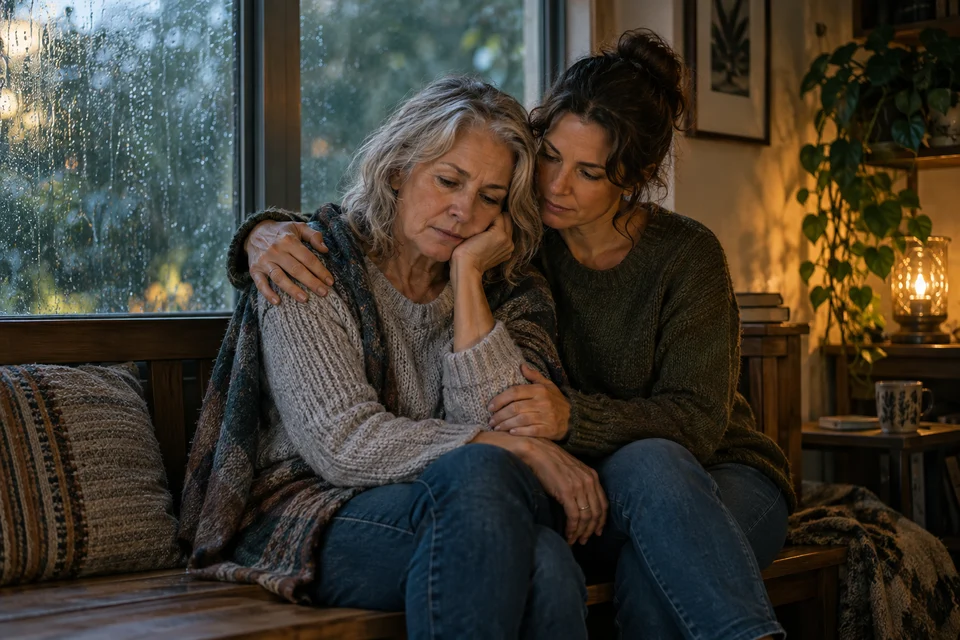
Ellen already had a counselor's appointment that afternoon. She had planned to cancel it because she could not imagine being useful in a conversation. Mara offered a ride. In the waiting area they sat on a bench near a rain-streaked window. Ellen held the appointment card even though they were already there.
She wondered if surrender meant she should stop wanting her mother back. The episode had not required grief to be finished before trust could be sincere. Ellen could not make herself grateful for the loss. She could ask God to meet her in it, and tell a counselor how difficult the nights had become.
When her name was called, she stood up slowly. Mara stayed to drive her home. Later they picked up soup, and Ellen contacted a recovery friend about support for the evening. The arrangements were small enough to follow. Nobody called them a breakthrough.
At home, one of her mother's scarves was still draped over the box. Ellen left it there. She answered one sympathy card with three plain sentences, then stopped. The kitchen grew dark around her, and this time she switched on the light before sitting down to eat. Tomorrow could remain tomorrow for another night.
In this episode
This conversation makes room for suffering within Christian faith and challenges the assumption that trust guarantees protection from loss. Surrender can coexist with unfinished grief; the discussion values trustworthy companions, counseling, and small acts of continuing when a hopeful future is hard to imagine.
A connection for everyday life
Our fictional story follows a grieving woman accepting company, professional care, and recovery support without manufacturing a lesson from her loss. Her anger and sorrow are not treated as proof that her faith or sobriety has failed.
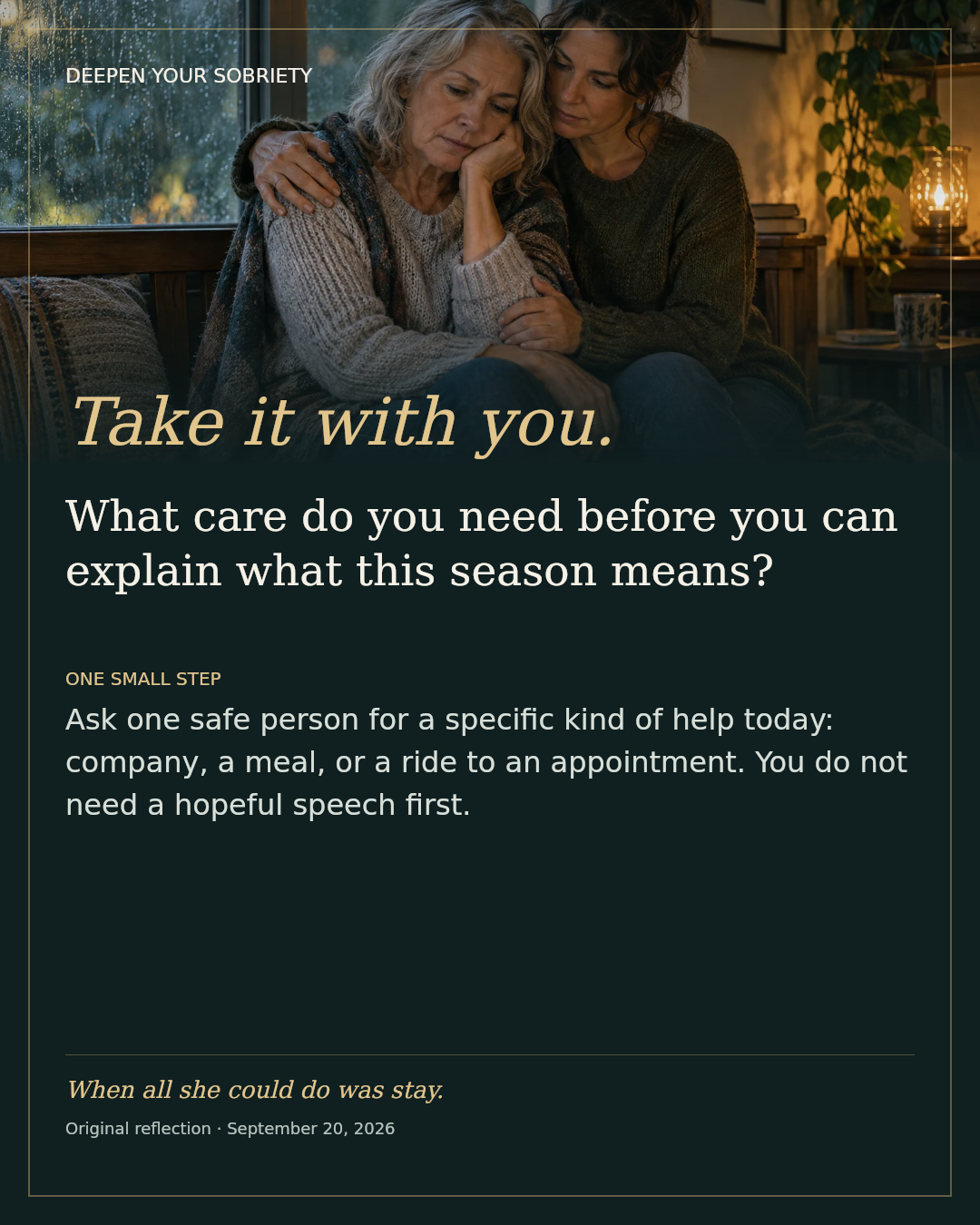
Take it with you.
Let the story become
one small step.
What care do you need before you can explain what this season means?
Ask one safe person for a specific kind of help today: company, a meal, or a ride to an appointment. You do not need a hopeful speech first.
Free 1080 × 1350 PNG. Save it to your phone or share it. Printable version · Browse all cards
If it opens as an image, use your browser’s Save Image option.
Deepen your connection.
Who came to mind while you were reading? Share this story with them—or simply let them know you’re thinking of them.
Deepen your faith with a Scripture reflection →Practical guide: your first recovery meeting →