
Five minutes on the porch.
Before anyone else woke up, Martin was already rehearsing what his son needed to hear. He had not considered listening.
An original, AI-assisted fictional story—not a real person’s testimony. Inspired by the episode below.
Published by Deepen Your Sobriety · A project by Chris
How our stories are made

Saturated x Deepen with Pastor Robby Gallaty
Deepen with Pastor Joby Martin · Episode aired September 17, 2026
Listen to this episodeAbout this story & its source
The full transcript of the official Church of Eleven22 episode video was reviewed through a third-party transcript service and checked against the publisher’s episode listing. The service did not identify whether captions were automated or publisher-authored; recognition errors may remain, and the audio was not independently checked. This is original, AI-assisted fiction, not testimony about Chris, Joby Martin, or an episode guest. No podcast dialogue is quoted.
For reflection and encouragement; this site does not provide counseling or treatment.
Uses your device voice. Keep this page open while listening.
Martin had typed the message three times before six. His son had canceled another Saturday visit, and Martin wanted to explain that eight months sober ought to count for something. The first version was angry. The second sounded reasonable. The third used the word disappointed twice, which made it feel less like anger without making it any kinder.
He carried his phone onto the porch. The chair scraped where it always scraped. Inside, the refrigerator motor stopped, leaving a silence he immediately wanted to fill. He opened the message again and added a sentence about how hard he was trying.
The night before, he had listened to the Saturated conversation with Robby Gallaty. The discussion of Peter had unsettled him: a man certain of his loyalty, making enormous promises, yet unable to stay awake and pray. Martin knew something about announcing the person he intended to become. He had announced that person over birthdays, kitchen tables, and the last fifteen minutes of more phone calls than he could remember.
What stayed with him was the invitation to begin small. A place. A few minutes. Attention returned to God when it wandered. He had expected an assignment that required a better Bible or a longer prayer. Five minutes in a chair sounded almost insulting. Surely there was something more useful he could do.
He set a timer, laid the phone face-down, and sat. Within seconds he was composing another defense. Then he noticed the defense and returned to a short prayer: Help me listen. He heard a truck stopping at the corner. He remembered an unpaid bill. He wondered whether this counted. Each time, he began again.
No voice explained his son's decision. No warmth arrived to certify that he had done it correctly. What became harder to ignore was an ordinary fact: the last time his son had visited, Martin had spent most of the afternoon explaining his recovery. He had asked very little about his son's life.
When the timer sounded, he called his sponsor. He said he wanted to send a message that would make his son feel guilty, though he had dressed it up as honesty. Saying that aloud was more uncomfortable than sitting still. His sponsor asked him to read the message before sending it. Martin read all three versions.
Then he wrote something shorter. He was sorry Saturday would not work. He hoped the week was going all right. There was no request for reassurance and no account of how much the cancellation hurt. He sent it only after they had talked through what he could reasonably ask of his son—and what he could not require.
His son did not reply that morning. Martin kept his counseling appointment and went to his evening meeting. Prayer had not removed those needs, or earned him a visit. It had given him a few minutes in which he was not the lawyer for his own case.
The next day, he put the folded blanket back on the porch chair. He was still disappointed. He still wanted credit. He sat down anyway, before opening the messages. For once, he had come without a speech.
In this episode
The conversation uses Peter in Matthew 26 to challenge self-reliance, approval seeking, and activity that outruns character. It invites prayerful dependence and a small, regular practice of returning attention to God, with patience when the mind wanders.
A connection for everyday life
Our fictional story applies that invitation to a father learning to pause before pressuring his son. Stillness supports honesty and accountable action; it does not secure another person's trust or replace counseling and recovery support.
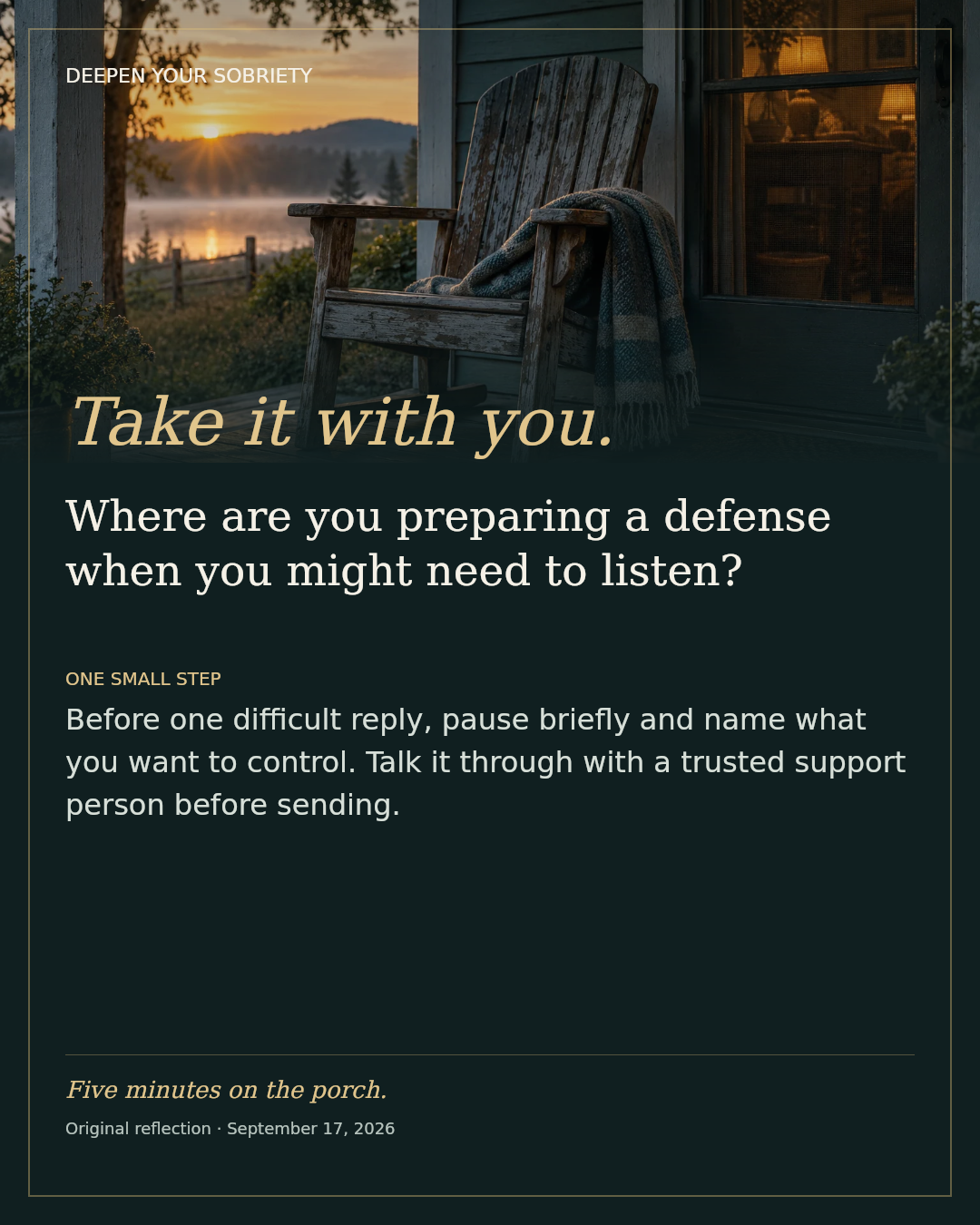
Take it with you.
Let the story become
one small step.
Where are you preparing a defense when you might need to listen?
Before one difficult reply, pause briefly and name what you want to control. Talk it through with a trusted support person before sending.
Free 1080 × 1350 PNG. Save it to your phone or share it. Printable version · Browse all cards
If it opens as an image, use your browser’s Save Image option.
Deepen your connection.
Who came to mind while you were reading? Share this story with them—or simply let them know you’re thinking of them.
Deepen your faith with a Scripture reflection →Practical guide: your first recovery meeting →