
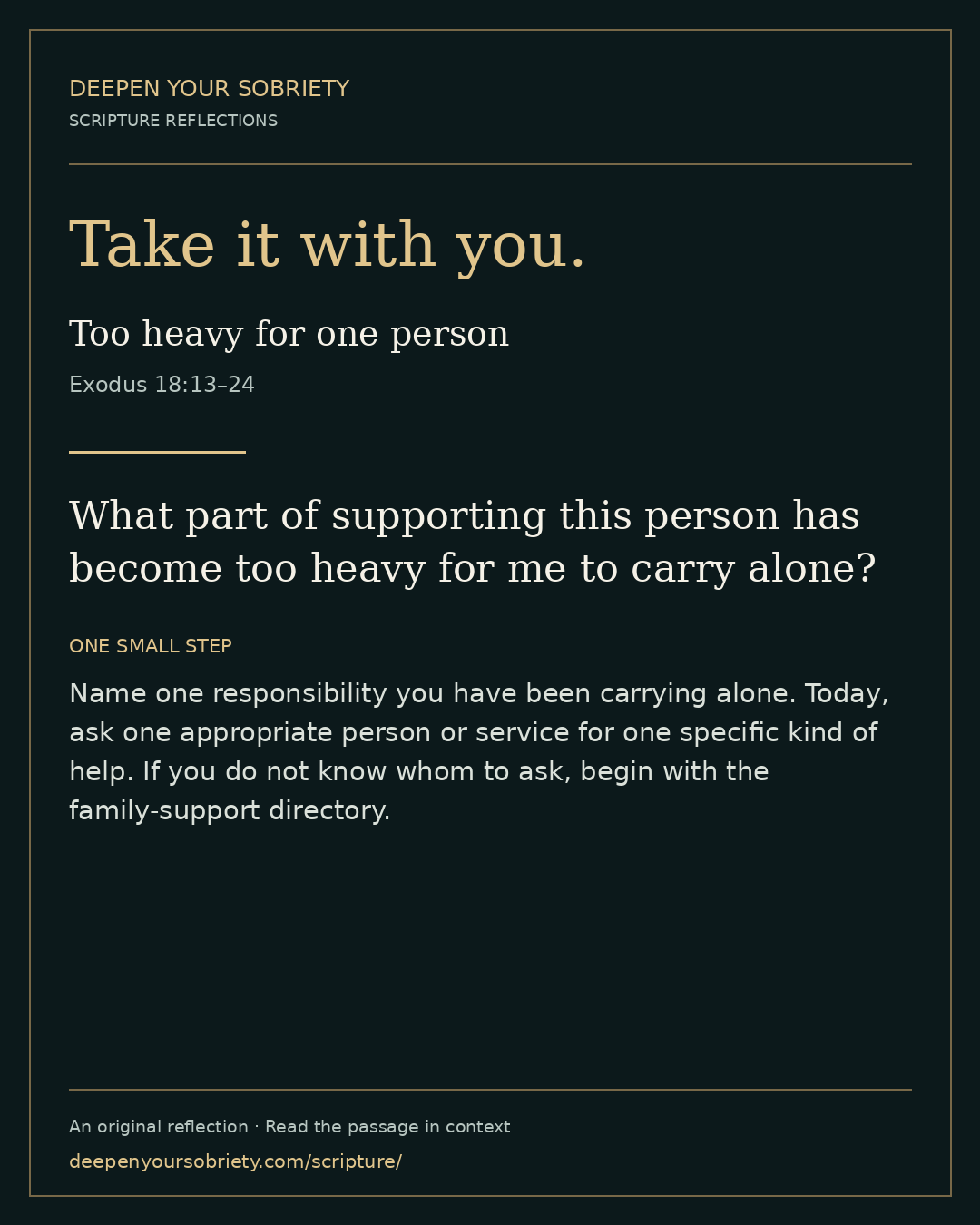
Too heavy for one person
Exodus 18:13–24 · Shared care, clear limits & support for supporters
An original, AI-assisted reflection from Deepen Your Sobriety · Published
Our editorial approach

Read Exodus 18 in context, especially verses 13–24“The thing that you do is not good. You will surely wear away, both you, and this people that is with you; for the thing is too heavy for you. You are not able to perform it yourself alone.”
Exodus 18:17–18 · World English Bible, Classic edition (public domain)
Before we bring it into recovery
Jethro watches Moses sit as judge from morning until evening while the people wait around him. Moses explains that people come to him with disputes and questions about God’s law. Jethro warns that the arrangement will wear out both Moses and the people. He advises Moses to keep teaching and representing the people before God while appointing trustworthy people to handle other matters. Moses listens and shares the work. This passage concerns leadership among Israel in the wilderness. The recovery connections below are our original application.
Our reflection
Supporting someone can slowly become a job with no off switch. You check the phone before your feet hit the floor. Later, you are arranging another ride or searching for the next program when everyone else has gone to bed. Each choice may begin as care. Together they can leave one person holding the entire system.
Jethro pays attention to the way care is organized. One person is carrying every question while everyone else waits. He says plainly that this will wear away both Moses and the people.
Families affected by addiction can fall into a similar pattern. You may become the coordinator, driver, counselor, and emergency plan. A wider circle can include the loved one’s chosen recovery supports and treatment professionals when your involvement is authorized. You also deserve people who support you, such as a family group, counselor, pastor, or trusted friend.
Sharing the load calls for care with privacy. Ask permission when it is appropriate and share only what another person needs in order to help. Immediate danger or a suspected overdose needs emergency help; do not wait for a family plan to work.
The person you love may decline the support you wish they would accept. You can still get help with your own part. Decide what you are able to do, stop covering something unsafe, and seek guidance for the choices that belong to you.
Exhaustion does not prove that you love less or pray poorly. It may be telling you that the arrangement needs to change. In Exodus 18, sharing responsibility helps the people as well as Moses. An exhausted person cannot remain the only doorway to every answer.
Jethro gives the work structure. The hard matters come to Moses; other matters go to trusted people. Your situation may not divide so neatly. Still, you can ask which responsibilities are yours, which belong to another adult, and which call for professional or community support.
One request can begin to make the load more honest. Choose one part that has become too heavy and ask one appropriate person or service to share it.
Take it with you.
What part of supporting this person has become too heavy for me to carry alone?
One small step
Name one responsibility you have been carrying alone. Today, ask one appropriate person or service for one specific kind of help. If you do not know whom to ask, begin with the family-support directory.
A prayer, if you would like one
God, help me see the weight I have been carrying alone. Show me whom I can ask for help, give me wisdom about privacy and limits, and care for everyone affected, including me.
Deepen your circle.
If this brought someone to mind, share it as part of your own reflection: “I realized I may need help carrying one part of this.”
A Christian reflection, not counseling or treatment. In an immediate U.S. crisis, call 988 or text 988. In immediate danger or a suspected overdose, call 911. These connections are our original editorial interpretation, not podcast teaching or statements from Joby Martin or The Church of Eleven22. This is not personal testimony or a claim of clinical or pastoral review. Questions and different readings are welcome. Send a private reflection or correction.