
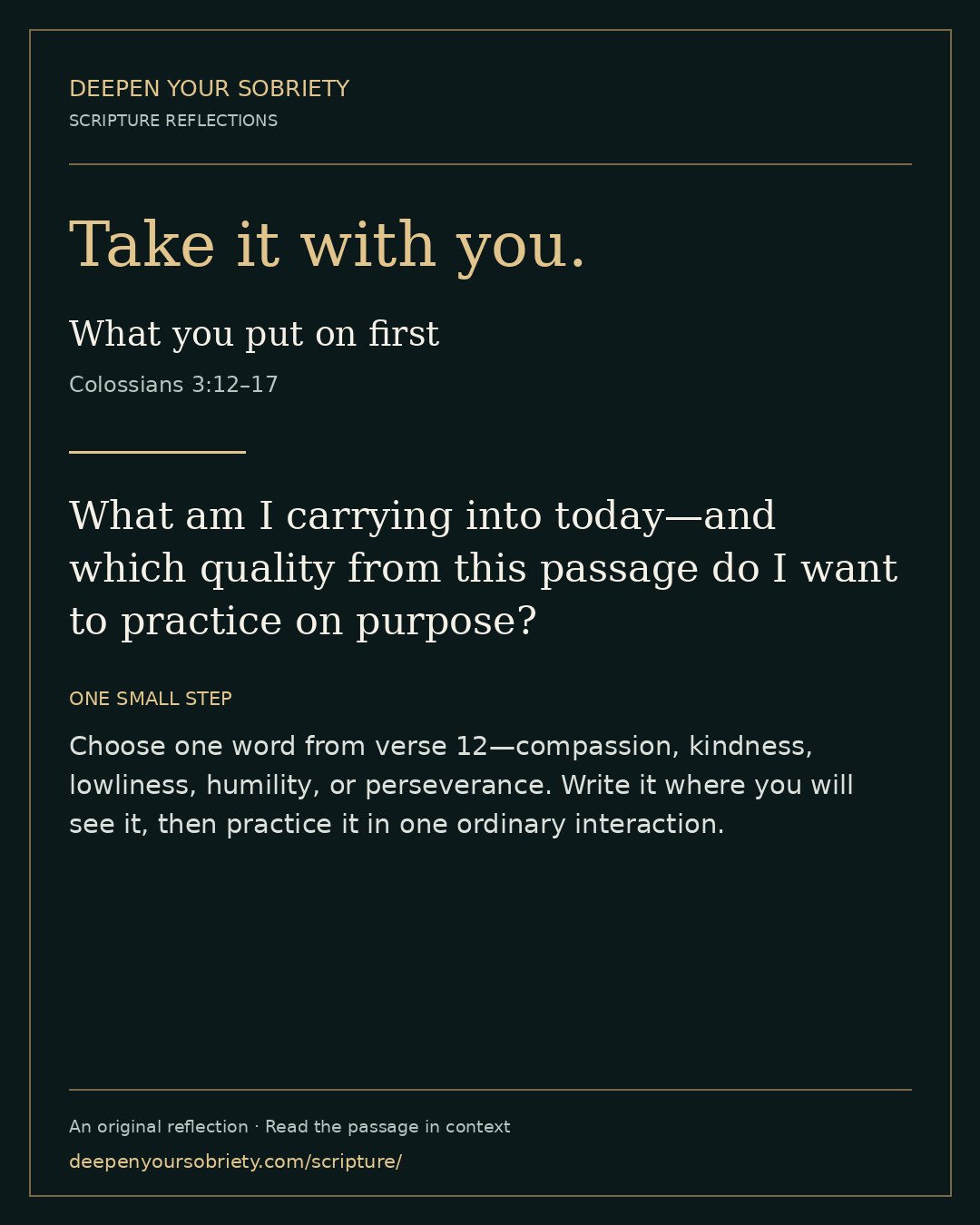
What you put on first
Colossians 3:12–17 · Compassion, patience & everyday faith
An original, AI-assisted reflection from Deepen Your Sobriety · Published
Our editorial approach

Read Colossians 3 in context, especially verses 12–17“Put on therefore, as God’s chosen ones, holy and beloved, a heart of compassion, kindness, lowliness, humility, and perseverance”
Colossians 3:12 · World English Bible, Classic edition (public domain)
Before we bring it into everyday life
Paul writes to a Christian community about living as people being renewed in Christ. Before giving an instruction, he names them “chosen,” “holy,” and “beloved.” Then comes a picture of shared life: compassion, kindness, humility, perseverance, forgiveness, love, peace, gratitude, and words shaped by Christ. These qualities are not a price paid to earn God’s love; the passage begins from belonging and moves toward practice.
Our reflection
Before we leave the house—or answer the first message—we put on more than clothes. We may carry yesterday’s argument, a schedule already running behind, a fear we have not named, or the determination not to need anyone today.
Faith can feel easier to recognize in a sanctuary, a meeting, or a moment when the right words come. Colossians brings it into smaller rooms. Compassion may show up in the kitchen. Humility may be needed in a text thread. Perseverance may look like staying with one honest task when the whole week feels too large.
“Put on” does not have to mean pretending. We do not need to disguise grief, anxiety, anger, cravings, depression, or exhaustion with a pleasant religious face. Hard symptoms are not proof of failed faith. Telling the truth about them—and asking for appropriate support—can itself be part of an honest life with God.
Practice can still begin before the feeling arrives. We can choose a compassionate question while we feel impatient. We can admit, “I did not listen well,” before pride has completely loosened its grip. We can thank someone for one real kindness without denying everything that remains difficult.
For a person in recovery, this may be the ordinary work of returning a call, keeping a commitment, or speaking without hiding. For someone supporting a loved one, it may be kindness with a clear boundary. For anyone trying to follow Jesus, it may be allowing one familiar room to become a place where love is practiced instead of merely admired.
Forgiveness in this passage is not permission for abuse, pressure to restore unsafe access, or a requirement to skip accountability. Compassion includes telling the truth about harm. Wisdom may involve distance, professional help, or support from people who understand what you are carrying.
The day may never feel especially spiritual. It can still hold a faithful next word, a patient next task, and one honest reason to give thanks.
Take it with you.
What am I carrying into today—and which quality from this passage do I want to practice on purpose?
One small step
Choose one word from verse 12—compassion, kindness, lowliness, humility, or perseverance. Write it where you will see it, then practice it in one ordinary interaction.
A prayer, if you would like one
God, thank you that I do not have to earn the name beloved. Meet me in the ordinary work of this day. Help me practice compassion without pretending, humility without disappearing, and perseverance without walking alone.
Deepen your practice.
Who might welcome this reflection today? Share it as an invitation to practice one small thing together, not as a measure of someone else’s faith.
A Christian reflection, not counseling or treatment. These connections are our original editorial interpretation, not podcast teaching or statements from Joby Martin or The Church of Eleven22. This is not personal testimony or a claim of clinical or pastoral review. Questions and different readings are welcome. Send a private reflection or correction.